
Why Personal Training Changes After 45

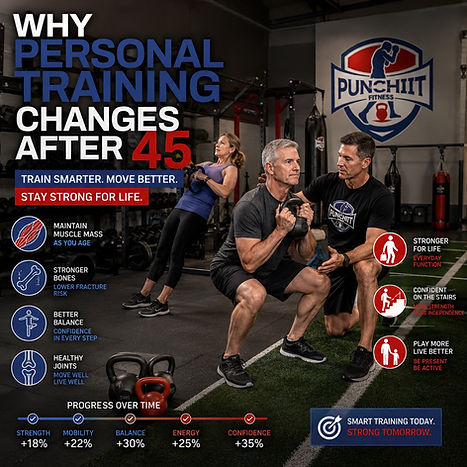
There comes a point where most people notice that their body doesn't respond quite the way it used to.
Recovery takes longer.
Old injuries seem to reappear without warning.
The knees become a little noisier.
The shoulders feel tighter.
Energy fluctuates more than it once did.
For some, these changes begin in their forties. Others don't notice them until their fifties or sixties. But eventually almost everyone reaches a point where the workouts that worked in their twenties no longer produce the same results.
That doesn't mean your best years are behind you.
It means your training needs to evolve.
One of the biggest misconceptions in fitness is that aging requires people to slow down or stop challenging themselves. In reality, research consistently shows that appropriately prescribed strength training remains one of the most effective ways to improve health, preserve independence, and maintain quality of life throughout adulthood.
The goal simply changes.
Instead of chasing exhaustion, we chase adaptation.
Instead of punishing the body, we build it.
Instead of trying to prove how hard we can work, we focus on how well we can move.
That's where high-quality personal training becomes invaluable.
Why This Matters More Than Ever
People are living longer than previous generations.
The question is no longer:
"How long will I live?"
It's becoming:
"How well will I live?"
Living another twenty or thirty years means little if those years are limited by chronic pain, weakness, poor balance, loss of independence, or preventable disease.
Many of the challenges people associate with "getting older" are not caused solely by age. They're often the result of years of reduced physical activity, declining muscle mass, decreased mobility, and progressively lower strength.
Fortunately, these are all highly trainable qualities.
Strength remains remarkably responsive to training well into later life.
So does balance.
So does mobility.
So does confidence.
What Actually Changes After 45?
Aging affects everyone differently, but several physiological trends become increasingly important.
Muscle Mass Naturally Declines
Beginning around middle age, adults gradually lose skeletal muscle if they don't actively train to preserve it.
This process—known as sarcopenia—is associated with:
reduced strength
slower metabolism
poorer balance
increased injury risk
reduced independence later in life
Fortunately, resistance training remains the most effective intervention for slowing—and often reversing—much of this decline.
Muscle is incredibly adaptable.
At PuncHIIT, we've watched clients in their sixties and seventies become significantly stronger than they were in their forties simply because they finally began training consistently.
Age doesn't eliminate the body's ability to adapt.
Inactivity does.
Recovery Changes
One of the biggest differences between training at 25 and training at 55 isn't motivation.
It's recovery.
Connective tissues generally recover more slowly.
Sleep quality may change.
Stress accumulates differently.
Hormonal shifts affect tissue repair.
This doesn't mean older adults should train less.
It means recovery becomes part of the training program.
The smartest programs balance challenge with recovery so each session builds upon the last instead of creating unnecessary setbacks.
Mobility Requires More Attention
Most adults don't suddenly "lose flexibility."
Instead, years of repetitive positions, sedentary work, previous injuries, and reduced movement variety gradually decrease joint mobility.
The answer isn't endless stretching.
It's purposeful movement.
Quality strength training performed through full, controlled ranges of motion often improves mobility while simultaneously building strength and stability.
Balance Becomes a Trainable Skill
Falls remain one of the leading causes of injury among older adults.
Yet balance is far from fixed.
It improves through:
unilateral training
carrying exercises
rotational movements
core stability
reactive drills
controlled changes in direction
Many people don't realize they're losing balance until after their first fall.
We'd rather improve it years beforehand.
Power Declines Faster Than Strength
One surprising finding from aging research is that muscular power—the ability to produce force quickly—often declines earlier and faster than maximal strength.
Power influences everyday tasks such as:
climbing stairs
catching yourself from a stumble
getting out of a chair
lifting luggage
reacting to slips
This is why appropriate medicine ball throws, kettlebell swings, fast sit-to-stands, and other carefully coached power exercises often become valuable additions to programs for healthy adults.
Power isn't just for athletes.
It's for anyone who wants to remain capable.
What Doesn't Change
While the body changes with age, the principles of effective training remain remarkably consistent.
Your body still responds to:
progressive overload
consistency
quality movement
sufficient recovery
proper nutrition
adequate protein intake
good coaching
The biggest mistake many adults make is assuming they need to stop lifting heavy weights altogether.
In reality, appropriately prescribed resistance training continues to improve strength, bone density, insulin sensitivity, cardiovascular health, and physical function across nearly every decade of life.
The question isn't whether you should lift.
It's how you should lift.
How Good Personal Training Evolves After 45
At PuncHIIT, we don't believe training should become easier after 45.
We believe it should become smarter.
A good coach spends less time trying to make every workout feel extreme and more time asking better questions.
Can this client squat comfortably?
How well do they recover?
Are they improving month after month?
Do they move confidently?
Can they carry groceries without pain?
Can they play with grandchildren?
Can they enjoy hiking, travelling, gardening, skiing, golf, pickleball, or boxing without limitations?
Those outcomes matter far more than simply burning calories.
Training becomes less about surviving workouts and more about building a body that's capable of living life well.
What a Personal Trainer Should Be Looking For
A quality trainer working with adults over 45 should assess far more than strength.
They should consider:
Movement quality
Joint mobility
Stability
Previous injuries
Balance
Coordination
Lifestyle
Sleep
Stress
Recovery
Medical history
Goals
Confidence
Exercise experience
Only then should the program begin.
Because no two 55-year-olds are alike.
One may be preparing to hike the Cabot Trail.
Another wants to return to tennis.
Another wants enough strength to get up off the floor independently.
Another simply wants to keep up with energetic grandchildren.
Each deserves a program built around their life—not someone else's.
Common Mistakes People Over 45 Make
One of the greatest obstacles to healthy aging isn't getting older.
It's believing outdated myths about getting older.
Mistake #1: "I'm Too Old to Lift Weights."
This is perhaps the most damaging myth of all.
Research consistently shows that adults in their 50s, 60s, 70s and even 80s can significantly improve:
Strength
Muscle mass
Bone density
Balance
Walking speed
Confidence
Independence
The body never completely loses its ability to adapt.
Mistake #2: Training Like You're Still 25
The opposite mistake is pretending nothing has changed.
Recovery matters.
Technique matters.
Sleep matters.
Stress matters.
Volume matters.
Instead of trying to prove you're still young, train to become the strongest version of your current self.
Ironically, that's often when people begin making their best progress.
Mistake #3: Chasing Calories Instead of Capability
Far too many workouts revolve around:
sweating more
burning calories
chasing exhaustion
None of those are long-term measures of success.
Ask yourself instead:
Am I stronger than three months ago?
Do I move better?
Can I get off the floor easier?
Can I carry more?
Does my back hurt less?
Do I recover faster?
Am I more confident?
Those are meaningful outcomes.
Mistake #4: Avoiding Strength Because of Pain
Pain doesn't automatically mean you should stop moving.
In many cases, the right amount of carefully prescribed movement is exactly what helps tissues become stronger and more resilient.
That doesn't mean ignoring pain.
It means learning which movements help and which aggravate symptoms.
This is where individualized coaching can make a tremendous difference.
Who Benefits Most?
Although this article is aimed at adults over 45, these principles apply to anyone who wants to age well.
Personal training is especially valuable for people who:
Have never strength trained before.
Are returning after years away from exercise.
Have recurring aches and pains.
Want to reduce their risk of falls.
Want to improve bone health.
Want to stay active in retirement.
Have been told to "just be careful."
Want to continue hiking, travelling, golfing, skiing, kayaking, gardening, or playing with grandchildren.
Simply want to feel capable again.
Healthy aging isn't reserved for elite athletes.
It's built by ordinary people making consistent, intelligent decisions over many years.
The PuncHIIT Perspective
At PuncHIIT Fitness, we don't see people over 45 as "older clients."
We see them as people entering one of the most important phases of their lives.
This is the stage where training shifts from being primarily about appearance to becoming an investment in your future independence.
Every program begins with understanding the individual in front of us.
We look at how you move, what you've experienced, where you want to go, and what matters most in your life.
From there, we build a program that is:
Purposeful
Progressive
Measurable
Individualized
Sustainable
Sometimes that means learning to squat without pain.
Sometimes it means deadlifting for the first time at age 62.
Sometimes it means rebuilding confidence after surgery.
Sometimes it means preparing to hike with your spouse in retirement.
There is no "one-size-fits-all" approach to healthy aging.
There is only the right program for you.
That's why our philosophy has always been:
STOP EXERCISING. START TRAINING.
Because training has a purpose.
Exercise often just fills time.
Key Takeaways
Getting older doesn't mean you should stop challenging your body.
Muscle, strength, balance, and mobility remain trainable throughout life.
Recovery becomes more important—but not less training.
Good coaching becomes increasingly valuable after 45.
Progress should be measured by function, capability, confidence, and quality of life—not just calories burned.
Strength training is one of the most effective tools available for promoting healthy aging.
It's never too late to become stronger than you are today.
Frequently Asked Questions
Is 45 too old to start strength training?
Not at all. Many people make their greatest strength gains after 45 because they begin following structured, progressive programs rather than random workouts.
Should I avoid heavy weights as I get older?
Not necessarily. "Heavy" is always relative to the individual. When technique is sound and progression is appropriate, lifting challenging loads can improve muscle, bone density, and overall function.
How many days per week should adults over 45 train?
For most people, two to four well-designed strength sessions per week is enough to produce excellent long-term results while allowing adequate recovery.
Should cardio still be part of my program?
Absolutely. Walking, cycling, rowing, boxing, interval training, and other forms of cardiovascular exercise complement strength training. The ideal balance depends on your goals, health status, and preferences.
Can personal training help if I already have aches and pains?
Often, yes. A qualified coach can modify exercises, improve movement mechanics, and gradually build resilience. Persistent or severe pain should also be assessed by an appropriate healthcare professional.
Coach's Corner
I've coached people for decades, and one thing has become crystal clear.
The people who stay active into their seventies and eighties aren't necessarily the ones who were the fittest at thirty.
They're the ones who never stopped learning.
They adapted.
They trained consistently.
They respected recovery.
They stayed curious.
And they kept showing up.
I've watched clients in their sixties perform their first proper squat.
I've seen people in their seventies deadlift safely for the first time.
I've watched confidence return after years of believing their body was simply "wearing out."
That's why I don't believe aging is something to fear.
I believe it's something to prepare for.
Every workout is either investing in your future—or neglecting it.
My advice?
Train for the person you want to be ten or twenty years from now.
Your future self will thank you for it.
— Coach Sonny Wilson
Suggested Internal Links
Personal Training
Group Fitness
Mobility Strong
Nutrition & AIP Coaching
Menopause Coaching
Related Reading
Unlocking The Fountain Of Youth: The Importance Of Strength Training As We Age
Strength Training For Stronger Bones: The Missing Piece Of Healthy Aging
https://www.punchiit.ca/post/strength-training-for-stronger-bones-the-missing-piece-of-healthy-aging
Deep Squats For Longevity: Building Knees That Last
https://www.punchiit.ca/post/deep-squats-for-longevity-building-knees-that-last
Hip Mobility & Strength: If You Want To Move Well At 70, Start At 40
https://www.punchiit.ca/post/hip-mobility-and-strength-if-you-want-to-move-well-at-70-start-at-40
How Personal Training Can Support Your Physiotherapy Journey
https://www.punchiit.ca/post/how-personal-training-can-support-your-physiotherapy-journey
Why We Love Working With The Clients Most Trainers Avoid
https://www.punchiit.ca/post/why-we-love-working-with-the-clients-most-trainers-avoid
References
American College of Sports Medicine. ACSM's Guidelines for Exercise Testing and Prescription.
American College of Sports Medicine. Position Stand: Progression Models in Resistance Training for Healthy Adults.
National Strength and Conditioning Association. Essentials of Strength Training and Conditioning.
World Health Organization. Guidelines on Physical Activity and Sedentary Behaviour.
Centers for Disease Control and Prevention. Physical Activity Guidelines for Older Adults.
National Institute on Aging. Exercise and Physical Activity: Your Everyday Guide from the National Institute on Aging.
Peterson MD, et al. Resistance Exercise for Muscular Strength in Older Adults: A Meta-analysis.
Fragala MS, et al. Resistance Training for Older Adults: Position Statement From the National Strength and Conditioning Association.
👉 Purchase a 1st Class Free Trial, explore our Group Fitness Classes in Halifax, then book your class using our mobile app … designed for all levels.
👉 Work 1-on-1 with a coach by booking a free initial consult using this link ... Personal Training in Halifax, choose your trainer, click the "Free Consult" button ... and discuss a fully customized approach.
🎯 STOP EXERCISING. START TRAINING 🎯


Comments