
The Missing Piece in Boxing Performance: Training Your Nervous System (Part 1 of 2)

Updated: Jul 27
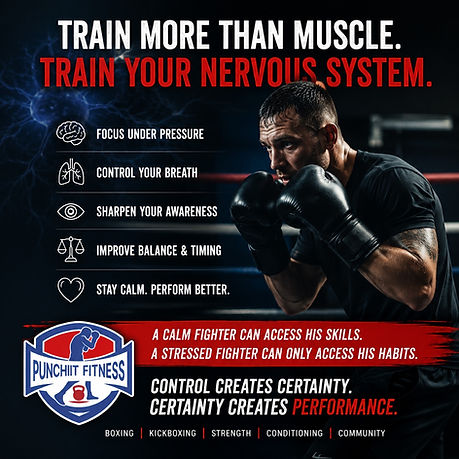
Most fighters spend countless hours training their muscles.
They hit the heavy bag.They run roadwork.They lift weights.They spar hard.
All of those things are important. But there's one critical component of performance that often gets overlooked:
Your nervous system.
In many cases, it's not your muscles that fail under pressure. It's your ability to access them when it matters most.
The Nervous System Controls Everything
Every movement you make starts with your nervous system.
It controls:
Breathing
Vision and focus
Reaction time
Balance and coordination
Timing and rhythm
Emotional regulation
Decision-making under pressure
When your nervous system is functioning well, everything feels smooth. Your reactions are sharp. Your movement feels effortless. You can think clearly while under stress.
When it isn't?
Technique breaks down.
Footwork becomes sloppy.
Breathing becomes erratic.
You start making mistakes you never make in training.
Sound familiar?
Why Some Fighters Shine in Training but Struggle in Competition
Almost every coach has seen it.
A fighter looks incredible in the gym.
They dominate sparring.Their conditioning is excellent.Their technique is sharp.
Then fight night arrives.
Suddenly they look hesitant, stiff, and unable to execute the skills they've practiced for months.
What happened?
Often, the issue isn't physical preparation.
It's nervous system overload.
When stress levels rise beyond what the nervous system can effectively manage, the brain begins prioritizing survival over performance.
Research in sports psychology consistently shows that excessive stress can impair reaction time, motor control, decision-making, and cognitive processing.
In simple terms:
A calm fighter can access their skills.
A stressed fighter can only access their habits.
That's why athletes who appear physically equal can perform dramatically differently when the pressure is highest.
Harder Isn't Always Better
Many athletes assume nervous system training means pushing harder.
More sparring. More rounds. More intensity.
But simply increasing stress doesn't automatically improve your ability to handle stress.
In fact, constantly training at maximum intensity can sometimes create the opposite effect.
The body becomes fatigued. Recovery suffers. Mental sharpness declines.
This is why many elite coaches carefully balance high-intensity sessions with recovery, technical work, breathing drills, visualization, and skill-based training.
The goal isn't just to tolerate stress.
The goal is to stay organized while experiencing stress.
What Nervous System Training Actually Looks Like
Nervous system training doesn't have to be complicated.
Some of the most effective methods include:
Controlled Breathing
Breathing directly influences your nervous system.
Learning to slow your breathing between rounds can help lower heart rate, improve focus, and maintain composure.
Many elite fighters use breathwork before training, during recovery periods, and even before walking to the ring.
Vision Training
Under stress, vision often narrows.
This "tunnel vision" can reduce awareness and make it harder to read opponents.
Simple drills that challenge peripheral awareness and visual tracking can help athletes maintain better situational awareness under pressure.
Balance and Coordination Work
The nervous system thrives on movement challenges.
Single-leg exercises, reaction drills, agility work, and coordination exercises help strengthen the communication between the brain and body.
Technical Sparring
Not every sparring session needs to be a war.
Controlled, technical rounds allow fighters to develop timing, awareness, and decision-making without overwhelming their nervous system.
Recovery
This may be the most overlooked aspect of all.
The nervous system doesn't get stronger during training.
It gets stronger during recovery.
Sleep, nutrition, hydration, mobility work, and stress management all play major roles in how well the nervous system functions.
This Applies Beyond Boxing
Even if you've never stepped into a ring, the same principles apply.
Your nervous system affects:
Strength training performance
Mobility
Coordination
Balance
Stress management
Injury recovery
Daily energy levels
Many people think they need to push harder.
Sometimes what they really need is to recover better, breathe better, and learn how to regulate stress more effectively.
How We Approach This at PuncHIIT Fitness
At PuncHIIT Fitness, we believe training should develop the entire athlete—not just their muscles.
Whether you're taking boxing lessons, kickboxing classes, personal training, or working through injury recovery, we focus on improving the communication between your brain and body.
That means:
Building strength
Improving movement quality
Developing coordination
Enhancing balance
Teaching breathing strategies
Managing training load appropriately
Helping you perform under pressure
Because true performance isn't just about how hard you can work.
It's about how well you can stay composed when things get difficult.
The strongest athlete in the room isn't always the one with the biggest muscles.
Often, it's the one whose nervous system remains calm, organized, and efficient when everyone else is falling apart.
That's where performance lives.
And that's where real confidence is built.
If you'd like to improve your boxing skills, athletic performance, recovery, or overall resilience, contact PuncHIIT Fitness today to learn how our coaches can help.
Suggested Internal Links
Boxing & Kickboxing Programs
Personal Training
Athletic Performance
Related Reading
Why Boxers Gas Out: It's Not Always Your Cardio
https://www.punchiit.ca/post/why-boxers-gas-out-nervous-system
Muscle Memory in Boxing: What It Really Means (And Why It Matters More Than You Think)
Can Boxing Be Started After Age 50?
https://www.punchiit.ca/post/can-boxing-be-started-after-age-50
Frequently Asked Questions
What role does the nervous system play in boxing performance?
Your nervous system controls reaction time, coordination, balance, force production, and movement efficiency. Even if you're strong and well-conditioned, an overloaded or fatigued nervous system can slow your reactions and reduce performance.
Can nervous system training improve punching power?
Yes. While strength is important, punching power also depends on how quickly and efficiently your nervous system recruits muscle fibers and coordinates movement from the ground up.
Why do experienced boxers make the sport look effortless?
Years of practice allow experienced athletes to automate movement patterns. They waste less energy, react more efficiently, and rely on refined motor control rather than excessive muscular effort.
How can I train my nervous system?
Quality skill practice, technical drills, reaction training, adequate recovery, sleep, and intelligent programming all contribute to a healthier, more responsive nervous system. Training harder isn't always the answer—sometimes training smarter produces better results.
👉 Purchase a 1st Class Free Trial, explore our Group Fitness Classes in Halifax, then book your class using our mobile app … designed for all levels.
👉 Work 1-on-1 with a coach by booking a free initial consult using this link ... Personal Training in Halifax, choose your trainer, click the "Free Consult" button ... and discuss a fully customized approach.
🎯 STOP EXERCISING. START TRAINING 🎯


Comments