
Why Knee Injuries Are So Common in Volleyball (And What You Can Do About Them)

Updated: Jul 15
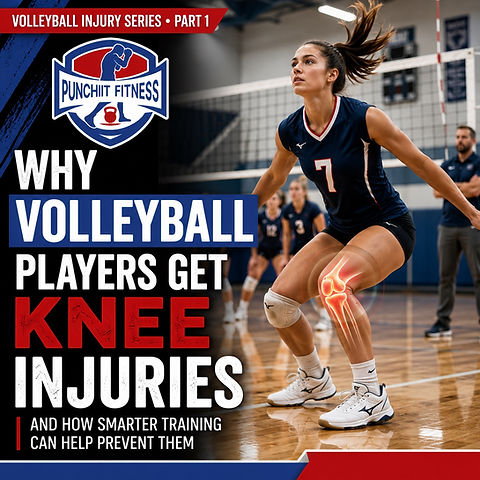
Volleyball is one of the most exciting sports to watch and play. It's fast, explosive, and demands exceptional athleticism.
Every rally involves jumping, landing, sprinting, diving, changing direction, and reacting in fractions of a second.
Unfortunately, those same demands also place tremendous stress on the knees.
Whether you're a recreational player, competitive athlete, parent of a young player, or coach, understanding why knee injuries happen is one of the best ways to reduce the risk of them occurring.
The good news is that many volleyball-related knee injuries are preventable. While no program can eliminate risk entirely, evidence consistently shows that appropriate strength training, improved movement mechanics, and smart workload management can significantly reduce injury rates.
At PuncHIIT Fitness, that's exactly what we mean when we say:
STOP EXERCISING – START TRAINING.
Training means preparing your body for the demands of your sport—not simply accumulating more hours playing it.
Why Volleyball Is So Demanding on the Knees
Elite volleyball players may perform hundreds of jumps during a single practice. Even recreational players accumulate thousands of landings over the course of a season.
Every landing sends forces several times body weight through the lower body.
Normally, your muscles absorb much of that force.
However, if an athlete is fatigued, lacks strength, has poor landing mechanics, or simply accumulates more training than their body can recover from, those forces begin to shift toward the tendons, ligaments, cartilage, and other passive structures surrounding the knee.
Over time, this can lead to overuse injuries.
In other situations, a single awkward landing or rapid change of direction can result in an acute injury such as an ACL tear or meniscus injury.
The Most Common Knee Injuries in Volleyball
Patellar Tendinopathy (Jumper's Knee)
This is arguably the most common knee problem seen in volleyball.
The patellar tendon connects the kneecap to the shin bone and transfers force every time an athlete jumps or lands.
Repeated loading without adequate recovery can gradually exceed the tendon's ability to adapt.
Common symptoms include:
Pain just below the kneecap
Pain during jumping
Pain after matches or practices
Morning stiffness
Reduced jumping performance
One important point is that complete rest is rarely the long-term solution. Tendons generally respond best to carefully progressed loading rather than prolonged inactivity. We'll explore this in greater depth in a future article.
ACL Injuries
The anterior cruciate ligament (ACL) helps stabilize the knee during cutting, pivoting, and landing.
Although volleyball involves relatively little player contact, ACL injuries frequently occur without any collision at all.
Many happen when an athlete lands with:
Excessive knee valgus ("knees collapsing inward")
Poor trunk control
Limited hip strength
High fatigue
Poor landing mechanics
Female athletes experience ACL injuries at substantially higher rates than males, likely because of a combination of anatomical, hormonal, neuromuscular, and biomechanical factors.
Fortunately, neuromuscular training programs have consistently demonstrated meaningful reductions in ACL injury risk.
Meniscus Injuries
The menisci are cartilage structures that help distribute force throughout the knee.
Twisting while the foot is planted or landing awkwardly may injure this tissue.
Symptoms often include:
Joint line pain
Swelling
Clicking
Locking
Difficulty fully bending or straightening the knee
Not every meniscus injury requires surgery, making an accurate assessment important.
Patellofemoral Pain
Sometimes called "runner's knee," this condition also affects volleyball athletes.
Pain usually develops around or behind the kneecap and often worsens during:
Squatting
Stairs
Jumping
Prolonged sitting
Rather than a single damaged structure, patellofemoral pain often reflects how multiple factors interact, including hip strength, movement quality, ankle mobility, training load, and recovery.
Why These Injuries Happen
Most volleyball knee injuries don't happen because the sport is inherently dangerous.
They happen because the demands placed on the athlete eventually exceed the body's capacity to tolerate them.
Some of the biggest contributors include:
Too Much Jumping
Jumping is essential to volleyball.
Doing too much, too soon—or without adequate recovery—can overload tendons and joints.
Poor Landing Mechanics
Landing isn't simply the end of a jump.
It's a skill.
Athletes who land stiffly, collapse inward at the knees, or fail to absorb force efficiently often place much greater stress on passive tissues.
Inadequate Strength
Strong muscles act as shock absorbers.
Weak glutes, quadriceps, hamstrings, calves, and trunk muscles reduce the body's ability to control movement under load.
Fatigue
Technique changes when athletes become tired.
Reaction time slows.
Movement quality decreases.
Decision-making becomes less efficient.
As fatigue accumulates, injury risk increases.
Limited Mobility
Restrictions at the ankles or hips often force the knees to compensate during jumping and landing.
Improving mobility where appropriate may reduce unnecessary stress on the knee.
Warning Signs You Shouldn't Ignore
Many overuse injuries begin with subtle warning signs.
Don't ignore:
Knee pain that lasts more than a few days
Pain during every jump
Increasing stiffness after activity
Swelling
Loss of confidence landing
Feeling like one leg is doing more work than the other
Addressing problems early is almost always easier than trying to recover after months of persistent symptoms.
Six Evidence-Based Ways to Reduce Your Risk
1. Strength Train Year-Round
Strength training increases the body's capacity to tolerate force.
Prioritize exercises such as:
Squats
Split squats
Romanian deadlifts
Single-leg Romanian deadlifts
Step-ups
Calf raises
Progressive overload—not random workouts—is what drives adaptation.
2. Learn to Land Well
Landing should be coached just as carefully as jumping.
Focus on:
Soft, quiet landings
Knees tracking over the feet
Controlled hip and knee flexion
Good trunk position
Balanced weight distribution
We'll devote an entire future article to landing mechanics because they're one of the most overlooked performance skills in volleyball.
3. Build Single-Leg Stability
Volleyball rarely happens with both feet perfectly planted.
Include:
Single-leg squats
Lateral step-downs
Single-leg balance drills
Multi-directional lunges
These improve control in the positions athletes actually encounter during play.
4. Progress Plyometrics Gradually
More jumping isn't always better.
Volume should increase progressively based on the athlete's experience, recovery, and competition schedule.
5. Respect Recovery
Adaptation happens after training—not during it.
Sleep, nutrition, hydration, and scheduled recovery all influence tissue health and performance.
Ignoring recovery eventually catches up with most athletes.
6. Don't Wait Until You're Hurt
One of the biggest mistakes athletes make is treating injury prevention as rehabilitation.
The best prevention program begins while you're healthy.
The PuncHIIT Perspective
At PuncHIIT Fitness, we believe athletes perform their best when their training prepares them for the demands of their sport—not simply when they spend more time playing it.
Volleyball practice develops volleyball skills.
Purposeful strength training develops the body's ability to express those skills repeatedly, safely, and efficiently.
That's the difference between exercising and training.
When we work with athletes, our goal isn't simply to help them become stronger.
We want them to jump more efficiently, land more confidently, move with greater control, recover more effectively, and remain available to compete throughout the season.
Because the best ability is still availability.
Key Takeaways
Knee injuries are among the most common injuries in volleyball.
Patellar tendinopathy and ACL injuries account for a large proportion of serious knee problems.
Many injuries occur without contact and are influenced by strength, landing mechanics, fatigue, and workload.
Progressive strength training, neuromuscular training, and smart recovery can substantially reduce injury risk.
Injury prevention isn't separate from performance training—it's one of the reasons effective training improves performance.
Volleyball will always demand a lot from your knees.
The goal isn't to eliminate those demands.
The goal is to prepare your body to meet them.
At PuncHIIT Fitness, that's what training is all about.
STOP EXERCISING – START TRAINING.
Continue the Volleyball Injury Series
Part 1: Why Volleyball Players Get Knee Injuries (You are here)
Suggested Internal Links
Volleyball Injury Series - (Parts 2-5) - links above
Research References
Bahr R, Bahr IA. Incidence of acute volleyball injuries: a prospective cohort study. Br J Sports Med.
Reeser JC, et al. Strategies for the prevention of volleyball-related injuries. Br J Sports Med.
Cumps E, Verhagen E, Meeusen R. Prospective epidemiological study of volleyball injuries. Br J Sports Med.
Hewett TE, Myer GD, Ford KR. Reducing knee and anterior cruciate ligament injuries among female athletes. J Knee Surg.
van der Worp H, et al. Risk factors for patellar tendinopathy. Br J Sports Med.
American College of Sports Medicine (ACSM). Resistance Training Guidelines.
National Strength and Conditioning Association (NSCA). Essentials of Strength Training and Conditioning.
👉 Purchase a 1st Class Free Trial, explore our Group Fitness Classes in Halifax, then book your class using our mobile app … designed for all levels.
👉 Work 1-on-1 with a coach by booking a free initial consult using this link ... Personal Training in Halifax, choose your trainer, click the "Free Consult" button ... and discuss a fully customized approach.
🎯 STOP EXERCISING. START TRAINING 🎯


Comments