
Jumper's Knee in Volleyball: Why Rest Alone Isn't the Answer

Updated: Jul 15
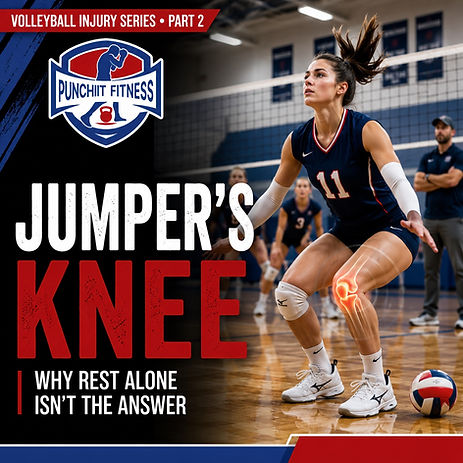
In Part 1 of our Volleyball Injury Series, we looked at why knee injuries are so common in volleyball and how purposeful training can significantly reduce injury risk.
One condition stood out above the rest.
Patellar tendinopathy, better known as jumper's knee, is one of the most common overuse injuries affecting volleyball players.
If you've ever felt pain just below your kneecap after practice or a tournament, you're certainly not alone.
The encouraging news is that jumper's knee is usually very manageable. Our understanding of tendon injuries has changed dramatically over the past two decades, and the old advice to simply "rest until it doesn't hurt" is no longer considered the most effective long-term solution for most athletes.
At PuncHIIT Fitness, we believe recovery should be purposeful, measurable, progressive, and individualized.
That's exactly what we mean when we say:
STOP EXERCISING – START TRAINING
What Is Jumper's Knee?
Despite the name, jumper's knee isn't caused by one bad jump.
It's an overuse injury involving the patellar tendon, the thick band of connective tissue that links your kneecap (patella) to your shinbone (tibia).
Every jump, landing, sprint, and explosive change of direction transfers force through this tendon.
Normally, the tendon adapts to these demands and becomes stronger.
Problems develop when the amount of loading consistently exceeds the tendon's ability to recover and adapt.
Unlike muscles, tendons receive a relatively limited blood supply and generally adapt more slowly. That means they often require more patience, more gradual progression, and more consistent loading to become resilient.
Modern research also tells us that patellar tendinopathy isn't simply an inflammatory condition.
Instead, the tendon undergoes structural and mechanical changes that reduce its ability to tolerate force efficiently.
That distinction helps explain why simply trying to reduce inflammation—or resting indefinitely—rarely solves the underlying problem.
Why Volleyball Players Are Especially at Risk
Few sports demand as much repetitive jumping as volleyball.
A competitive player may perform hundreds of jumps during a single practice and thousands over the course of a season.
The issue isn't a single jump.
It's the cumulative workload.
Risk increases when athletes experience:
Sudden increases in training volume
Multiple tournaments over a short period
Limited recovery between sessions
Poor lower-body strength
Inefficient landing mechanics
Returning too quickly after time away from sport
Often, it's the combination of these factors—not one dramatic moment—that gradually overloads the tendon.
What Does Jumper's Knee Feel Like?
Athletes commonly report:
Pain directly below the kneecap
Pain while jumping or landing
Pain during squats
Morning stiffness
Tenderness when pressing on the tendon
Reduced jumping performance
One of the most confusing aspects of jumper's knee is that symptoms often improve after warming up.
Unfortunately, feeling better during practice doesn't necessarily mean the tendon has recovered.
As the condition progresses, pain often begins earlier during activity, lasts longer afterward, and may eventually interfere with everyday movements.
Ignoring these warning signs usually allows the condition to become more difficult to manage.
Is It Really Jumper's Knee?
Not every sore knee in a volleyball player is jumper's knee.
Several conditions can produce similar symptoms.
Understanding the differences can help you decide when it's time to seek an assessment.
Jumper's Knee (Patellar Tendinopathy)
Often presents with:
Pain directly below the kneecap
Pain during jumping
Morning stiffness
Tenderness over the patellar tendon
Symptoms that improve after warming up but return later
Patellofemoral Pain Syndrome
Often causes:
Pain around or behind the kneecap
Pain while climbing stairs
Pain during squats
Pain after sitting for prolonged periods
General aching rather than pinpoint tendon pain
Meniscus Injury
May involve:
Pain after twisting the knee
Swelling
Catching or locking sensations
Difficulty fully straightening or bending the knee
ACL or Other Ligament Injuries
These injuries typically involve:
A sudden injury
A popping sensation in some cases
Rapid swelling
Instability or the feeling that the knee may give way
When Should You See a Healthcare Professional?
Persistent knee pain isn't something to ignore.
Consider seeking an assessment if you experience:
Pain lasting longer than one to two weeks despite reducing activity
Significant swelling
Locking or catching of the knee
Repeated episodes of instability
Difficulty bearing weight comfortably
A popping sensation followed by immediate swelling
Symptoms that continue worsening rather than improving
An accurate diagnosis is important because different knee conditions often require different treatment approaches.
While many cases of jumper's knee respond well to progressive loading and strength training, other injuries may require imaging, rehabilitation, or referral to an appropriate healthcare professional.
Why Rest Alone Usually Doesn't Solve the Problem
This is one of the biggest misconceptions surrounding tendon injuries.
Complete rest often decreases pain because the tendon is no longer being stressed.
However, reducing pain isn't the same as increasing the tendon's ability to tolerate volleyball again.
Imagine your tendon currently has the capacity to tolerate 60 units of force, while volleyball demands 100 units.
Avoiding activity doesn't magically increase that capacity.
Purposeful training does.
That's why modern rehabilitation focuses on progressively rebuilding the tendon's ability to tolerate force instead of simply eliminating discomfort.
Training the Tendon to Tolerate Volleyball Again
Successful rehabilitation usually involves several complementary strategies.
Progressive Strength Training
Heavy, controlled resistance training encourages the tendon to adapt over time.
Common exercises include:
Squats
Split squats
Romanian deadlifts
Step-ups
Leg press
Calf raises
The objective isn't to lift the heaviest weight possible.
It's to progressively challenge the tendon within an appropriate range.
Isometric Exercises
Holding certain exercises for 30–45 seconds may temporarily reduce pain while maintaining muscle activation.
Examples include:
Wall sits
Spanish squats
Isometric leg press holds
These exercises aren't a cure, but they can be a useful tool during rehabilitation.
Gradual Return to Jumping
Eventually, the tendon needs to tolerate volleyball-specific movements again.
Jumping volume should increase progressively based on symptoms, recovery, and overall training load.
Returning too quickly is one of the most common reasons symptoms return.
How Much Pain Is Acceptable?
One question athletes often ask is whether they should stop every time they feel discomfort.
Current tendon rehabilitation guidelines generally suggest that some mild discomfort during exercise may be acceptable, provided the pain remains manageable, doesn't progressively worsen during the session, and settles within a reasonable period afterward.
Persistent or increasing pain, however, is a sign that the tendon may be receiving more load than it can currently tolerate.
A qualified healthcare professional can help determine what level of loading is appropriate for your individual situation.
Common Mistakes Athletes Make
Playing Through Significant Pain
Pain is valuable feedback.
Ignoring it repeatedly often prolongs recovery.
Resting Completely for Weeks
While temporary reductions in activity may sometimes be appropriate, complete inactivity rarely improves the tendon's long-term capacity.
Returning Too Soon
Many athletes feel better before the tendon has regained its ability to tolerate full volleyball demands.
Returning too early frequently results in setbacks.
Ignoring Strength Training
Practicing volleyball develops volleyball skills.
Strength training develops the physical qualities that allow those skills to be expressed safely and consistently.
Both are essential.
Can Jumper's Knee Be Prevented?
No strategy completely eliminates injury risk.
However, research consistently supports several practices that can substantially reduce the likelihood of tendon problems.
These include:
Maintaining lower-body strength throughout the year
Monitoring jumping volume
Progressing training gradually
Prioritizing recovery
Improving landing mechanics
Addressing pain early rather than waiting for it to worsen
One of the biggest mistakes athletes make is treating injury prevention as something that begins after pain develops.
The best prevention program starts long before symptoms appear.
The PuncHIIT Perspective
At PuncHIIT Fitness, we don't believe athletes should wait until they're injured before they start training properly.
Volleyball practice develops volleyball skills.
Purposeful strength and conditioning develops resilient athletes.
Those aren't the same thing.
Your patellar tendon doesn't know whether you're playing in a championship match or performing a controlled split squat.
It simply responds to the amount of force placed upon it—and whether that force is progressed appropriately over time.
That's why our philosophy is:
STOP EXERCISING – START TRAINING
The goal isn't simply to recover from injury.
The goal is to build a body that's better prepared for the demands of volleyball so you can continue performing at your best throughout the season.
Key Takeaways
Jumper's knee is one of the most common overuse injuries in volleyball.
It develops when the patellar tendon is repeatedly loaded beyond its current capacity.
Rest alone often reduces pain but doesn't restore the tendon's ability to tolerate volleyball.
Progressive strength training and carefully managed loading are central to modern rehabilitation.
Monitoring symptoms early and training consistently can help reduce the likelihood of long-term tendon problems.
Volleyball places tremendous demands on the knees, but pain doesn't have to become an accepted part of the sport.
With an appropriate assessment, evidence-informed rehabilitation, and purposeful training, many athletes can return to the court stronger and more resilient than before.
Because recovering from an injury isn't the finish line.
Building a body that's better prepared for the demands of your sport is.
Continue the Volleyball Injury Series
Part 2: Jumper's Knee: Why Rest Alone Isn't the Answer (You are here)
Suggested Internal Links
Volleyball Injury Series - (Parts 1,3-5) - links above
Research References
Malliaras P, Cook JL, Purdam CR, Rio E. Patellar Tendinopathy: Clinical Diagnosis, Load Management, and Advice for Challenging Case Presentations. Journal of Orthopaedic & Sports Physical Therapy. 2015.
Cook JL, Purdam CR. Is Tendon Pathology a Continuum? A Pathology Model to Explain the Clinical Presentation of Load-Induced Tendinopathy. British Journal of Sports Medicine. 2009.
Rio E, Kidgell D, Purdam C, et al. Isometric Exercise Induces Analgesia and Reduces Inhibition in Patellar Tendinopathy. British Journal of Sports Medicine. 2015.
Kongsgaard M, Kovanen V, Aagaard P, et al. Corticosteroid Injections, Eccentric Decline Squat Training and Heavy Slow Resistance Training in Patellar Tendinopathy. American Journal of Sports Medicine. 2009.
van der Worp H, van Ark M, Roerink S, et al. Risk Factors for Patellar Tendinopathy: A Systematic Review of the Literature. British Journal of Sports Medicine. 2011.
American College of Sports Medicine (ACSM). ACSM's Guidelines for Exercise Testing and Prescription.
National Strength and Conditioning Association (NSCA). Essentials of Strength Training and Conditioning.
👉 Purchase a 1st Class Free Trial, explore our Group Fitness Classes in Halifax, then book your class using our mobile app … designed for all levels.
👉 Work 1-on-1 with a coach by booking a free initial consult using this link ... Personal Training in Halifax, choose your trainer, click the "Free Consult" button ... and discuss a fully customized approach.
🎯 STOP EXERCISING. START TRAINING 🎯


Comments