
Strength Training for Women Over 40: What Science Really Says

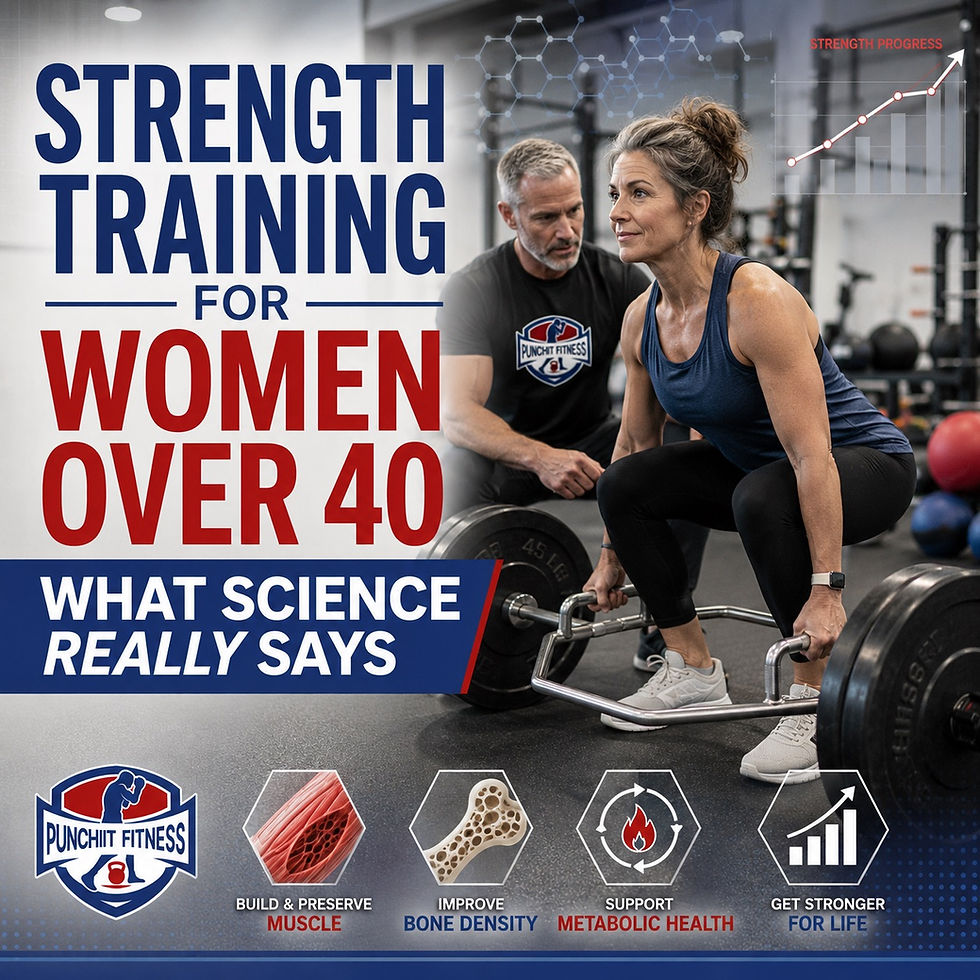
If you spend even a few minutes scrolling through social media, you'll quickly find countless opinions about what women over 40 should eat, how they should train, whether they should fast, whether cardio is "bad," or whether hormones explain everything.
Some of that advice is rooted in good science.
Some of it isn't.
The good news is that researchers now understand far more about women's physiology than they did even a decade ago. While women—particularly those in midlife and beyond—have historically been underrepresented in exercise and medical research, that gap is gradually narrowing. As the evidence grows, one message continues to emerge with remarkable consistency:
Strength training isn't simply another form of exercise. It is one of the most effective tools available for protecting health, independence, and quality of life as women age.
At PuncHIIT Fitness, we've coached women through every stage of life—from young athletes to women in their 70s and beyond. Although every individual is different, one pattern remains remarkably consistent:
The women who prioritize building strength tend to move better, recover better, remain more independent, and often feel more confident than those who focus exclusively on burning calories.
That isn't about appearance.
It's about building a body that's prepared for the decades ahead.
Why Muscle Matters More Than Most People Realize
For years, muscle was viewed largely as something that helped us move or influenced how we looked.
Today's research paints a much bigger picture.
Skeletal muscle functions as an endocrine organ, releasing signaling molecules called myokines that influence numerous systems throughout the body. Researchers continue to study how these myokines affect inflammation, metabolism, bone, brain health, and immune function.
Muscle also serves as the body's largest reservoir for glucose disposal, making it one of the most important tissues for maintaining healthy blood sugar and insulin sensitivity.
As estrogen declines during perimenopause and menopause, many women naturally experience:
Reduced muscle mass
Increased body fat
Greater insulin resistance
Reduced metabolic flexibility
Strength training directly addresses many of these changes by preserving—or even increasing—lean muscle tissue.
In other words, muscle is not simply cosmetic.
It is metabolically protective.
The Hidden Cost of Losing Muscle
Beginning around our 30s, adults gradually lose muscle mass unless they actively train to maintain it.
For women, this process often accelerates during the menopausal transition.
Losing muscle doesn't just mean becoming weaker.
It can also contribute to:
Reduced balance
Slower walking speed
Greater fall risk
Loss of independence
Reduced metabolic rate
Poorer glucose regulation
Increased risk of frailty later in life
These changes happen gradually, which is exactly why they often go unnoticed until they begin affecting everyday activities.
The goal isn't simply to avoid becoming weak.
It's to remain capable.
Bone Health Depends on More Than Calcium
Many women associate osteoporosis prevention with calcium supplements.
While calcium and vitamin D certainly play important roles, they represent only part of the picture.
Bone responds to mechanical loading.
When muscles pull against bone during resistance training, the skeleton adapts by maintaining—or in some cases increasing—bone density.
Estrogen helps regulate the balance between bone formation and bone breakdown. During menopause, declining estrogen accelerates bone loss, increasing the risk of osteopenia and osteoporosis.
Research consistently shows that appropriately prescribed resistance training improves bone health.
Adding impact activities—such as jumping, hopping, or multidirectional movements when appropriate—may provide additional benefits for certain individuals.
The message isn't that everyone should immediately begin jumping onto boxes.
It's that bones need meaningful mechanical challenges to remain strong.
Can Women With Osteoporosis Lift Heavy?
For years, many women diagnosed with osteoporosis were advised to avoid lifting heavy weights.
Research over the past decade has challenged that assumption.
One of the most influential studies, the LIFTMOR trial, demonstrated that postmenopausal women with low bone density could safely perform high-intensity resistance training under qualified supervision. Participants experienced improvements in bone density and strength without an increase in fractures during the supervised program.
The important distinction is that "heavy" is always relative to the individual.
Heavy for one person may be a 15-pound kettlebell.
For another, it may be a 200-pound deadlift.
Training should always begin with excellent technique and progress gradually according to the individual's abilities and medical history.
The Myth of "Toning" With Light Weights
One of the most persistent myths in the fitness industry is that women should lift light weights for high repetitions to become "toned."
Physiologically, muscles don't become toned.
They become larger, smaller, stronger, or weaker.
The lean appearance people often describe as "toned" comes from having sufficient muscle combined with relatively low body fat.
While lighter weights certainly have a place—particularly for rehabilitation, endurance, or learning movement patterns—building meaningful strength generally requires progressively increasing resistance over time.
That doesn't mean every workout must leave you exhausted.
It means the body must continue receiving a stimulus significant enough to adapt.
Doing the same routine with the same weights month after month eventually produces the same results.
Protein Becomes Increasingly Important After 40
The current Recommended Dietary Allowance (RDA) for protein is designed to prevent deficiency—not necessarily to optimize muscle growth, recovery, or healthy aging.
Many researchers now recommend higher protein intakes for active adults, particularly older adults and those performing resistance training.
Current evidence generally supports approximately:
1.2–2.2 grams of protein per kilogram of body weight per day, depending on activity level, age, and goals.
Equally important is distributing protein across meals rather than consuming most of it at dinner.
Adequate protein helps support:
Muscle protein synthesis
Recovery
Bone health
Satiety
Healthy aging
Strength training provides the stimulus.
Protein provides much of the building material.
Both matter.
Cardio Still Matters—Just Not in the Way Many People Think
Strength training should form the foundation of most fitness programs for women over 40.
That doesn't mean cardiovascular training becomes unimportant.
Aerobic fitness remains one of the strongest predictors of longevity.
Current evidence supports incorporating a combination of:
Regular moderate aerobic activity
Occasional higher-intensity interval training when appropriate
Daily movement such as walking
Resistance training at least two to three times per week
Rather than asking whether strength or cardio is "better," a better question is:
How can they work together?
Recovery Is Part of Training
The body doesn't become stronger during the workout.
It becomes stronger while recovering from it.
Quality sleep, sufficient nutrition, stress management, and intelligent programming all influence recovery.
Women navigating perimenopause and menopause often experience sleep disturbances, changes in body temperature, and fluctuations in energy that may require adjustments to training volume or intensity.
That's not failure.
That's individualized coaching.
The best program is one that adapts to the person—not one that forces every person into the same template.
Nutrition Should Support Health, Not Restriction
Nutrition advice often swings between extremes.
One week carbohydrates are the enemy.
The next week it's fat.
Then comes fasting.
While nutrition science continues to evolve, several principles remain remarkably consistent:
Eat adequate protein.
Include plenty of vegetables and fibre.
Choose healthy fats regularly.
Minimize ultra-processed foods most of the time.
Maintain a sustainable eating pattern you can follow for years rather than weeks.
Consistency almost always beats perfection.
The Importance of Individualized Programming
Perhaps the most important lesson emerging from current research is that there is no universal prescription for every woman.
Age, medical history, injury history, menopause status, medications, training experience, sleep quality, stress, and personal goals all influence what an effective program looks like.
That's why cookie-cutter workouts often fall short.
Effective training isn't random.
It's individualized.
The PuncHIIT Perspective
After more than 30 years of coaching, one lesson stands out above almost everything else:
Women are capable of far more than they've often been led to believe.
We've watched clients arrive convinced they should never lift "heavy," only to discover that progressively building strength improved their confidence, movement, energy, and quality of life in ways they never expected.
That doesn't mean every woman should chase personal records or train like a competitive athlete.
It means every woman deserves a program that challenges her appropriately, progresses over time, and respects where she is today while preparing her for tomorrow.
That's the difference between exercising and training.
At PuncHIIT Fitness, we believe training should always be purposeful, measurable, progressive, individualized, and sustainable.
Because our goal isn't simply helping people exercise today.
It's helping them remain strong enough to enjoy life for decades to come.
STOP EXERCISING — START TRAINING.
Key Takeaways
Muscle supports far more than movement—it plays an important role in metabolic health, healthy aging, and maintaining independence.
Progressive strength training is one of the most effective strategies for preserving muscle and bone as women age.
Resistance training can often be performed safely by women with low bone density when properly supervised and individualized.
Protein requirements for active women are generally higher than the minimum RDA designed to prevent deficiency.
Cardiovascular fitness remains important, but it should complement—not replace—strength training.
Recovery, sleep, and nutrition are essential parts of an effective training program.
The best results come from individualized, progressive programs rather than one-size-fits-all workouts.
Frequently Asked Questions
Can women over 40 safely lift heavy weights?
Yes. When exercises are taught correctly and progressed gradually, strength training is safe for most women and offers significant benefits for muscle, bone density, and overall health. If you have osteoporosis or another medical condition, consult your healthcare provider and work with a qualified coach.
How many days per week should women strength train?
Most adults benefit from two to four strength-training sessions per week, depending on experience, recovery, and goals.
Will lifting heavier weights make women bulky?
For most women, no. Building large amounts of muscle requires years of dedicated training, nutrition, and favourable genetics. Most women become stronger, leaner, and more physically capable without becoming excessively muscular.
How much protein do women over 40 need?
While individual needs vary, active women typically benefit from around 1.2–2.2 grams of protein per kilogram of body weight per day, especially if they are strength training.
Is cardio still important after menopause?
Absolutely. Cardiovascular exercise supports heart health and longevity, but it should complement a progressive strength-training program rather than replace it.
Suggested Internal Links
Personal Training
Nutrition & AIP Coaching
Group Fitness Schedule
Related Reading
Women and Strength Training: Building Bone Density & Preventing Osteoporosis
Healthy Fitness Goals: What Should You Really Aim For
Stop Exercising, Start Training: Why Random Workouts Fail
References
American College of Sports Medicine. ACSM's Guidelines for Exercise Testing and Prescription.
National Strength and Conditioning Association. Essentials of Strength Training and Conditioning.
Beck BR, et al. Heavy Resistance Training in Postmenopausal Women With Low Bone Mass (LIFTMOR Trial). Journal of Bone and Mineral Research. 2018.
Morton RW, et al. Protein intake to maximize resistance training adaptations. British Journal of Sports Medicine. 2018.
Phillips SM. Nutritional supplements in support of resistance exercise to counter age-related sarcopenia. Advances in Nutrition. 2015.
Pedersen BK, Febbraio MA. Muscles, exercise and obesity: skeletal muscle as a secretory organ. Nature Reviews Endocrinology. 2012.
ACSM Position Stand: Resistance Exercise for Health and Fitness.
World Health Organization. Physical Activity Guidelines.
👉 Purchase a 1st Class Free Trial, explore our Group Fitness Classes in Halifax, then book your class using our mobile app … designed for all levels.
👉 Work 1-on-1 with a coach by booking a free initial consult using this link ... Personal Training in Halifax, choose your trainer, click the "Free Consult" button ... and discuss a fully customized approach.
🎯 STOP EXERCISING. START TRAINING 🎯


Comments