
Am I Eating Enough? Why Under-Fueling Could Be Holding Back Your Strength, Recovery, and Long-Term Health

Updated: Aug 6
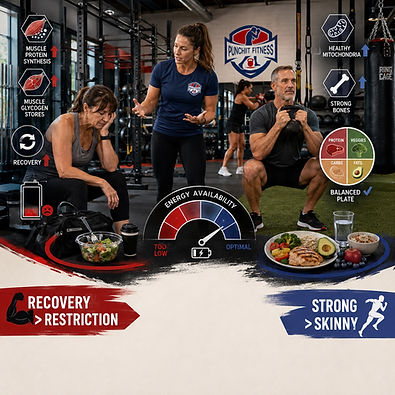
"I don't eat very much."
It's one of the most common things we hear from new clients.
Sometimes they say it proudly.
Sometimes they say it with frustration.
Sometimes they genuinely can't understand why they're always tired, why they're not getting stronger, or why the scale refuses to move despite "barely eating."
After talking through their day, a pattern often emerges.
Breakfast might be nothing more than coffee.
Lunch is a quick salad.
Dinner is reasonably balanced, but it's the first substantial meal they've eaten all day.
They've been trying to "be good," yet they constantly feel hungry, sluggish, sore, and discouraged.
Ironically, many people who believe they're eating too much are actually eating too little to support the life they're trying to live.
At PuncHIIT Fitness, we remind clients that there is a significant difference between eating less and fueling your body well.
Remember:
Stop Exercising. Start Training.
Training has a purpose.
That purpose requires fuel.
Why Eating Enough Matters
Your body isn't simply trying to survive today's workout.
It's trying to recover from yesterday's, prepare for tomorrow's, maintain muscle, support your immune system, regulate hormones, protect your bones, power your brain, and keep every organ functioning around the clock.
Food isn't merely calories.
Food is information.
Food is construction material.
Food is recovery.
Food is adaptation.
When you consistently under-fuel, your body begins making compromises.
It doesn't ask permission.
It simply prioritizes survival.
That means:
slower recovery
reduced muscle growth
lower training performance
increased fatigue
poorer concentration
reduced motivation
impaired immune function
greater injury risk
hormonal disruption
The body is remarkably adaptable—but adaptation works both ways.
If you consistently provide too little energy, your body adapts by becoming more conservative with it.
Under-Eating Doesn't Always Look Like Starvation
One of the biggest misconceptions is that under-fueling only affects elite athletes or people with eating disorders.
In reality, we frequently see it in busy adults.
Teachers.
Healthcare workers.
Parents.
Business owners.
Shift workers.
People who are constantly rushing from one responsibility to another.
Many simply don't eat enough because they're busy—not because they're intentionally dieting.
Others have spent years believing that eating less is always healthier.
Unfortunately, those habits often catch up with them once they begin strength training.
Suddenly they're asking:
"Why am I exhausted after every workout?"
"Why am I always sore?"
"Why can't I lift heavier?"
"Why am I hungry all the time?"
"Why has my fat loss stalled?"
The answer isn't always "train harder."
Sometimes it's "fuel better."
The Hidden Cost of Chronic Under-Fueling
Your body has priorities.
Building stronger muscles is not at the top of the list.
Before it invests energy into improving athletic performance, it first has to maintain:
your brain
your heart
your lungs
your liver
your kidneys
your immune system
your nervous system
If there isn't enough energy available, building new muscle becomes optional.
Recovery slows.
Performance drops.
Progress stalls.
Many people mistakenly believe this means they need to work harder.
Often, they actually need to recover better.
And recovery starts long before you sleep.
It starts with eating enough.
Strength Training Changes Your Nutritional Needs
Someone who walks occasionally has different nutritional requirements than someone who regularly participates in:
strength training
boxing
kickboxing
kettlebell classes
metabolic conditioning
interval training
personal training
Training deliberately creates stress.
That stress is beneficial—but only if your body has the resources to adapt.
Think of your workouts as placing an order with your body.
You're asking it to:
build stronger muscles
improve bone density
strengthen tendons
improve cardiovascular fitness
increase work capacity
improve insulin sensitivity
become more resilient
Your nutrition determines whether your body can actually fill that order.
Without enough energy and protein, recovery becomes incomplete.
Eventually, incomplete recovery becomes stalled progress.
Muscle Is Expensive Tissue
Your body loves muscle...
...but only when it can afford it.
Muscle requires energy to build.
Protein to repair.
Calories to maintain.
If energy intake remains chronically low, the body may begin breaking down muscle tissue to meet other needs.
This becomes especially important after the age of 40.
As we age, maintaining muscle becomes more challenging due to natural changes in anabolic sensitivity and hormone levels.
Strength training provides the stimulus.
Nutrition provides the building materials.
Without both, the results are limited.
The Science of Energy Availability
One concept that has received increasing attention in sports nutrition is energy availability.
In simple terms, energy availability is the amount of dietary energy left over for your body to perform all of its normal functions after accounting for the energy you expend during exercise.
Think of it like your monthly household budget.
If every dollar goes toward paying the mortgage, there's nothing left for groceries, car maintenance, or emergencies.
Your body works the same way.
After your workouts, it still has to support:
Brain function
Hormone production
Immune health
Bone remodeling
Muscle repair
Reproductive health
Digestion
Sleep
Tissue healing
Everyday movement
When there isn't enough energy available, your body begins reducing investment in systems that aren't immediately necessary for survival.
That might not seem like a big deal after one busy day.
But weeks or months of chronic under-fueling can gradually lead to:
decreased training performance
slower recovery
recurring injuries
illness
persistent fatigue
hormonal disturbances
loss of muscle mass
reduced bone density
Researchers now recognize this spectrum as Relative Energy Deficiency in Sport (RED-S). Although it was originally studied in elite athletes, we now know it can also affect recreational exercisers, endurance athletes, and active adults who unintentionally eat too little.
The important point isn't the diagnosis itself.
It's recognizing that your body needs adequate fuel if you expect it to become stronger, healthier, and more resilient.
Why Eating More Can Sometimes Improve Fat Loss
This idea surprises almost everyone.
"I want to lose fat... why would I eat more?"
Because fat loss isn't simply about eating as little as possible.
Yes, creating a calorie deficit is generally necessary for reducing body fat.
However, the size and duration of that deficit matter.
A small, sustainable deficit while maintaining adequate protein intake and resistance training often produces better long-term results than severe restriction.
When calories become excessively low, several things can happen:
You move less without realizing it
Your body unconsciously conserves energy.
You fidget less.
Walk less.
Stand less.
Take fewer stairs.
These seemingly tiny reductions in daily movement can substantially reduce total calorie expenditure.
Training quality declines
It's difficult to build or preserve muscle when every workout feels like survival.
Weights become heavier.
Intervals become slower.
Recovery takes longer.
Instead of progressing, you begin maintaining—or even losing—fitness.
Hunger increases
Extreme restriction often leads to powerful biological signals encouraging you to eat.
This isn't a lack of willpower.
It's your body attempting to protect itself.
Muscle loss becomes more likely
Without sufficient protein and total energy, your body may begin using muscle tissue as fuel.
Since muscle is metabolically active and essential for long-term health, losing it makes future weight management more challenging.
The goal should never be to simply become lighter.
The goal should be to become leaner, stronger, healthier, and more capable.
Signs You May Not Be Eating Enough
Many clients assume they'll know immediately if they're under-fueling.
Unfortunately, the signs often develop gradually.
Ask yourself whether several of these sound familiar:
You're constantly tired despite sleeping enough.
You struggle to recover between workouts.
Your performance has plateaued or declined.
You feel unusually irritable.
You experience persistent brain fog.
You're always thinking about food.
Your strength has stopped improving.
Small injuries keep appearing.
You frequently get sick.
You're cold when everyone else feels comfortable.
Your workouts feel harder than they used to.
You're no longer excited to train.
One sign by itself doesn't necessarily indicate under-fueling.
However, several occurring together should prompt a closer look at both your nutrition and recovery.
Protein Matters—But It Isn't Everything
Protein has become the superstar of the nutrition world—and for good reason.
It supports:
muscle repair
muscle growth
satiety
immune function
healthy aging
For most active adults, aiming for approximately 1.2–2.0 grams of protein per kilogram of body weight per day is supported by current evidence, with higher intakes often benefiting those trying to preserve muscle during fat loss or healthy aging.
However, protein alone cannot compensate for inadequate overall nutrition.
Imagine trying to build a house.
Protein is the lumber.
But you still need:
bricks
concrete
wiring
windows
workers
electricity
Similarly, your body also requires sufficient carbohydrates, healthy fats, vitamins, minerals, fluids, and total energy.
Recovery depends on the complete package.
Don't Fear Carbohydrates
Few nutrients have been unfairly criticized as often as carbohydrates.
Yet for many active people, carbohydrates remain the body's preferred fuel during higher-intensity exercise.
That includes activities like:
boxing
kickboxing
kettlebell circuits
boot camps
interval training
heavy strength sessions
Carbohydrates help replenish muscle glycogen, which fuels repeated bouts of high-intensity effort.
Chronically restricting carbohydrates may contribute to:
reduced performance
slower recovery
earlier fatigue
poorer training quality
This doesn't mean everyone needs enormous amounts of carbohydrates.
It means they should match intake to their activity level.
Someone training five or six times per week has different nutritional requirements than someone who walks twice weekly.
Nutrition should support the demands of your training—not follow trends on social media.
Healthy Fats Are Essential Too
Healthy fats sometimes get overlooked when conversations focus solely on protein.
Yet dietary fats play essential roles in:
hormone production
vitamin absorption
brain health
cell membranes
inflammation regulation
long-term cardiovascular health
Extremely low-fat diets maintained over long periods are rarely necessary and often make eating enjoyable, satisfying meals much more difficult.
Choosing mostly unsaturated fats from foods such as olive oil, nuts, seeds, avocados, and fatty fish is consistent with current nutrition recommendations for overall health.
Nutrition After 40: Why It Matters Even More
As we get older, preserving muscle becomes increasingly important.
Muscle isn't simply about appearance.
Healthy muscle supports:
balance
bone density
metabolic health
insulin sensitivity
independence
injury prevention
confidence
longevity
Adults naturally lose muscle mass with age if they don't challenge it.
Strength training slows that process.
Adequate nutrition supports it.
Together, they're among the most powerful investments you can make in healthy aging.
This is one reason our coaching philosophy has shifted away from chasing smaller bodies and toward building stronger, more capable people.
At PuncHIIT, we'd much rather help someone carry their grandchildren, travel confidently, climb stairs without pain, or continue boxing into their 70s than simply lose another five pounds.
Strength is freedom.
Fuel makes strength possible.
Practical Ways to Fuel Your Training Better
The good news is that most people don't need a complicated nutrition plan or an app that tracks every calorie.
They simply need to become more intentional about eating enough of the right foods at the right times.
Here are a few coaching principles we use regularly with our clients:
1. Don't Skip Breakfast If You Train Early
If you train in the morning, your body has already gone 8–10 hours without food.
Even a light meal before training can improve energy, concentration, and workout quality.
Some simple options include:
Greek yogurt with berries
Overnight oats
Whole-grain toast with peanut butter and banana
Eggs with fruit
A smoothie containing protein, fruit, and oats
Not everyone enjoys eating first thing in the morning, but consistently training on an empty tank isn't ideal for many active adults.
2. Include Protein at Every Meal
Rather than trying to consume all your protein at dinner, spread it throughout the day.
Examples include:
eggs
Greek yogurt
cottage cheese
chicken
turkey
fish
lean beef
tofu
legumes
quality protein supplements when appropriate
This helps support muscle repair throughout the day instead of asking your body to do everything overnight.
3. Don't Be Afraid to Eat Around Your Workout
One of the biggest mistakes we see is clients avoiding food before and after exercise because they're trying to "burn more fat."
In reality, eating appropriately around training often leads to:
better performance
improved recovery
higher-quality workouts
greater muscle retention
more consistent long-term progress
Remember...
You're fueling your training—not undoing it.
4. Build Balanced Meals
Rather than obsessing over individual nutrients, start with a simple plate.
Aim for:
a quality protein source
colourful vegetables
fruit
whole-grain or starchy carbohydrates appropriate to your activity level
healthy fats
Simple usually beats perfect.
5. Recovery Doesn't End When the Workout Does
Many people believe recovery begins once they leave the gym.
In reality, recovery continues for the next 24–48 hours.
Sleep.
Hydration.
Stress management.
Nutrition.
Movement.
They all work together.
Missing one piece makes the others less effective.
Common Nutrition Mistakes We See
Over the years, we've noticed some recurring patterns.
Chasing the Lowest Possible Calories
The goal isn't to eat as little as you can.
The goal is to eat enough to support your goals while creating an appropriate calorie balance over time.
Treating Every Carbohydrate Like the Enemy
Carbohydrates aren't inherently "good" or "bad."
They're simply one of the body's primary fuel sources.
The amount you need depends on your activity level.
Believing Hunger Equals Progress
Feeling hungry all day isn't a badge of honour.
Persistent hunger may simply indicate that your body needs more food.
Learning the difference between occasional appetite and chronic under-fueling is an important coaching skill.
Ignoring Recovery
People often spend an hour planning workouts...
...and about thirty seconds thinking about recovery.
The workout is the stimulus.
Recovery is where adaptation actually happens.
Comparing Yourself to Someone Else
Nutrition is highly individual.
A retired couple attending three Group Strength classes per week will have different needs than:
a competitive boxer
a shift-working nurse
a menopausal woman beginning strength training
a parent juggling work and three children
There is no universal meal plan.
That's why coaching matters.
Who Benefits Most From Eating Enough?
Everyone benefits from appropriate nutrition, but it's especially important if you:
strength train regularly
attend boxing or kickboxing classes
participate in HIIT workouts
want to lose fat while maintaining muscle
are over 40
are approaching or experiencing menopause
are recovering from an injury
feel constantly tired despite exercising
struggle to recover between sessions
These are exactly the people we work with every day.
The PuncHIIT Perspective
At PuncHIIT Fitness, we don't believe in punishing your body into becoming healthier.
We believe in training it to become stronger, more resilient, and more capable.
That philosophy extends well beyond what happens during your workout.
Nutrition isn't about earning food or burning it off.
It's about giving your body the resources it needs to adapt to the training you're asking it to do.
For some people, that may mean creating a modest calorie deficit to support fat loss.
For others, it may mean eating more to recover properly, preserve muscle, improve energy, and continue making progress.
That's why we don't hand every client the same nutrition advice.
A 30-year-old competitive boxer, a 52-year-old woman beginning strength training, and a 65-year-old retiree focused on healthy aging all have different needs.
Our role as coaches is to meet people where they are and help them build sustainable habits that support long-term success.
Because training isn't about surviving today's workout.
It's about becoming healthier for years to come.
Key Takeaways
Eating too little can impair recovery, performance, and long-term health.
Strength training increases your body's need for energy and nutrients.
Protein is important, but total energy intake matters too.
Carbohydrates are valuable fuel for high-intensity exercise.
Healthy fats support hormones, brain health, and recovery.
Building and maintaining muscle becomes increasingly important after age 40.
Recovery begins with adequate nutrition—not just rest.
Sustainable progress almost always beats aggressive restriction.
Frequently Asked Questions
How do I know if I'm eating enough?
If you're recovering well, maintaining energy, progressing in your training, sleeping reasonably well, and not experiencing constant hunger or fatigue, your intake is likely supporting your current activity. If you're unsure, working with a qualified nutrition coach can help.
Can I lose fat while eating enough?
Yes. Fat loss generally comes from maintaining a sustainable calorie deficit—not from eating as little as possible. Adequate protein, resistance training, and a moderate energy deficit can help preserve muscle while reducing body fat.
Should I eat before every workout?
Not necessarily, but many people perform and recover better with some food before training, particularly if the session is long or high intensity. The best approach depends on your schedule, preferences, and goals.
Is protein the most important nutrient?
Protein is essential for muscle repair and healthy aging, but it isn't the only nutrient that matters. Your body also requires carbohydrates, healthy fats, vitamins, minerals, fibre, and enough total energy to function well.
Can under-eating slow my progress?
Absolutely. Chronic under-fueling can reduce training performance, slow recovery, increase injury risk, and make it harder to build or maintain muscle.
Coach's Corner
After more than three decades of coaching, I've noticed something interesting.
Very few people fail because they aren't working hard enough.
Most are already working incredibly hard.
They're raising families, building careers, caring for parents, dealing with stress, and still making time to exercise.
The missing piece usually isn't motivation.
It's recovery.
I've watched clients transform not because they started eating less, but because they finally started eating well. Their workouts improved. Their energy returned. They became stronger. They recovered faster. In many cases, their body composition improved as well.
Your body isn't trying to work against you.
It's trying to work with the resources you give it.
If you're asking it to train harder, recover faster, and stay healthy for decades, don't forget to give it the fuel to do the job.
Because at PuncHIIT Fitness, we don't just exercise.
We train with purpose.
Suggested Internal Links
Personal Training
Nutrition & AIP Coaching
Group Fitness
Group Strength
Boxing & Kickboxing
Related Reading
Why Just Eat Less Misses the Mark for Active People
https://www.punchiit.ca/post/why-just-eat-less-misses-the-mark-for-active-people
Stop Trying to Shrink Your Way Into the Body You Want
https://www.punchiit.ca/post/stop-trying-to-shrink-your-way-into-the-body-you-want
Protein Timing: Fat Loss Plateau
https://www.punchiit.ca/post/protein-timing-fat-loss-plateau
GLP-1 Medications: The Benefits, The Drawbacks & Why Strength & Nutrition Still Matter
Strength Training for Women Over 40
https://www.punchiit.ca/post/strength-training-for-women-over-40
References
American College of Sports Medicine. ACSM's Guidelines for Exercise Testing and Prescription.
International Society of Sports Nutrition Position Stand: Protein and Exercise.
World Health Organization. Healthy Diet Guidelines.
National Strength and Conditioning Association. Essentials of Strength Training and Conditioning.
Mountjoy M, et al. IOC Consensus Statement on Relative Energy Deficiency in Sport (RED-S).
Phillips SM. A Brief Review of Critical Processes in Exercise-Induced Muscular Hypertrophy.
Morton RW, et al. Protein supplementation to support resistance exercise-induced gains in muscle mass and strength: A systematic review and meta-analysis.
👉 Purchase a 1st Class Free Trial, explore our Group Fitness Classes in Halifax, then book your class using our mobile app … designed for all levels.
👉 Work 1-on-1 with a coach by booking a free initial consult using this link ... Personal Training in Halifax, choose your trainer, click the "Free Consult" button ... and discuss a fully customized approach.
🎯 STOP EXERCISING. START TRAINING 🎯


Comments